


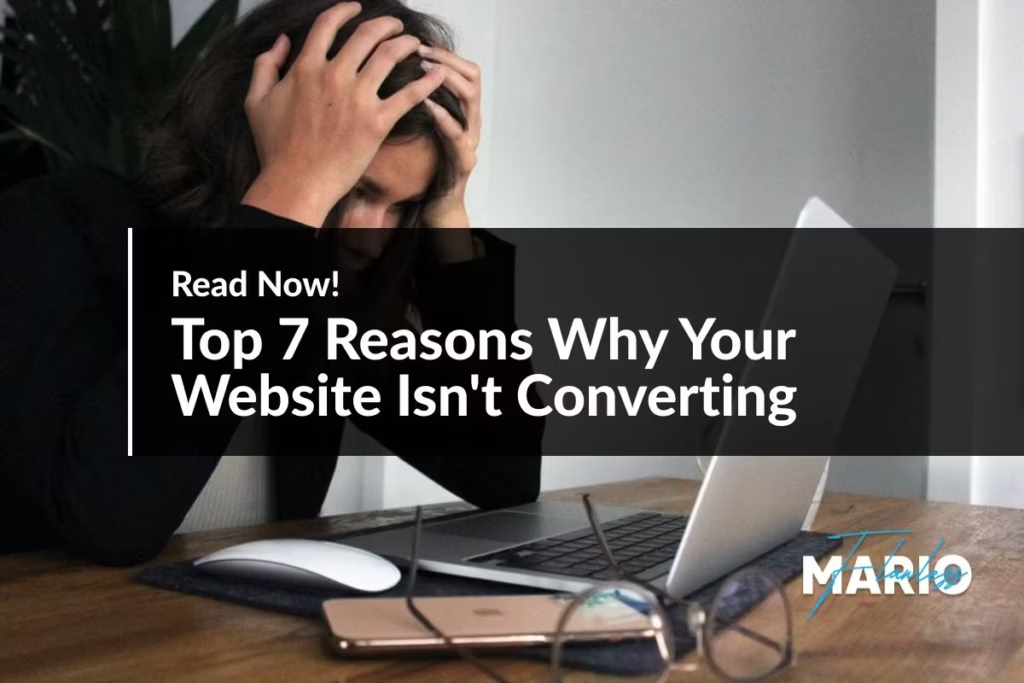
There is a quiet frustration many business owners carry but rarely articulate.
Your website is live.
You’ve invested time, money, and effort into driving traffic.
People are visiting.
But they are not converting.
No inquiries.
No consistent leads.
No measurable return.
At first, the instinct is to question everything else, pricing, product quality, even market demand. But in many cases, the real issue lies elsewhere.
It is in the words.
More specifically, in the absence of a strategic sales script.
A website is not merely a digital presence. At its best, it is a carefully engineered conversation, one that guides a visitor from curiosity to conviction, and ultimately, to action.
When that conversation is unclear, misdirected, or incomplete, conversion suffers.
In this article, we examine seven critical sales script mistakes that often go unnoticed, yet quietly erode your ability to turn visitors into clients.
1. The Cost of a Weak First Impression
Every interaction begins with a moment of decision.
Within seconds of landing on your website, a visitor determines whether to stay or leave. That decision is shaped primarily by one element; your headline.
A vague or generic headline signals uncertainty. It fails to anchor the visitor or communicate relevance.
“Welcome to Our Website” may be polite, but it is ineffective.
In contrast, a headline that clearly articulates value creates immediate alignment:
“Helping Service-Based Businesses Turn Website Visitors Into Paying Clients.”
This is not merely a stylistic improvement. It is a strategic one.
A strong headline answers three silent questions:
- Who is this for?
- What problem does it solve?
- What outcome can I expect?
Without these answers, attention is lost before engagement begins.
2. When the Brand Becomes the Center of the Story
Another subtle yet costly misstep is an inward focus.
Many websites speak extensively about the company; its journey, its passion, its achievements. While these elements have their place, they are often introduced too early.
The visitor arrives with a different priority: their problem.
When your messaging centers on “we” instead of “you,” it creates distance rather than connection.
Effective sales scripts reverse this dynamic. They position the client as the protagonist and the business as the guide.
This shift is not cosmetic, it is foundational.
It signals empathy, relevance, and understanding, all of which are prerequisites for trust.
3. The Silence of an Unclear Call-to-Action
Clarity does not end with messaging. It must extend to direction.
A website without a clear call-to-action creates uncertainty. Visitors may be interested, even convinced, but unsure of the next step.
“Learn More” is often too passive to prompt meaningful action.
In contrast, decisive language such as:
- “Book a Free Consultation”
- “Get Your Website Audit”
- “Start Your Project Today”
provides both clarity and momentum.
A well-placed call-to-action is not an afterthought. It is the natural conclusion of a well-structured conversation.
4. The Hidden Cost of Ambiguity
Clarity is one of the most underestimated drivers of conversion.
When a visitor cannot quickly understand what you offer, they disengage. Not because they lack interest, but because they lack certainty.
Ambiguity creates hesitation. Hesitation delays action. And delay often leads to exit.
A strong sales script removes this friction by articulating:
- What you do
- Who you serve
- What results you deliver
In doing so, it replaces confusion with confidence.
5. The Absence of Narrative
Beyond clarity lies connection.
Facts inform, but stories persuade.
A website that presents only information risks feeling transactional and impersonal. In contrast, one that incorporates storytelling creates emotional resonance.
Transformation is particularly powerful:
- What was the client’s challenge?
- What changed?
- What result was achieved?
These narratives allow visitors to see themselves within the journey, and to envision their own outcomes.
In this way, storytelling becomes more than a creative choice. It becomes a strategic tool for conversion.
6. Trust Is Not Assumed; It Is Built
Every visitor arrives with an unspoken question:
“Can I trust this?”
In the absence of proof, doubt persists.
Trust signals (testimonials, case studies, measurable results, and portfolio work) serve as evidence. They validate your claims and reduce perceived risk.
Importantly, trust is cumulative. Each element reinforces the next.
A single testimonial may spark interest. A consistent pattern of results builds conviction.
Without these signals, even the most compelling messaging can fall short.
7. When the Journey Lacks Direction
Finally, there is the structure itself.
A website is not a collection of pages. It is a guided experience.
When that experience is disjointed or unclear, visitors struggle to navigate it. Even strong individual elements lose effectiveness without a cohesive flow.
An effective structure follows a deliberate sequence:
- Capture attention
- Define the problem
- Present the solution
- Build credibility
- Guide action
This progression mirrors a natural decision-making process.
When aligned correctly, it transforms your website from a static platform into a dynamic conversion tool.
Conclusion
A non-converting website is rarely the result of chance.
It is often the outcome of misaligned messaging, unclear structure, or the absence of a strategic sales script.
The encouraging reality, however, is that these challenges are not permanent.
When your website begins to communicate with clarity, empathy, and intention, its role changes. It moves from being a passive presence to an active participant in your growth.
It begins to attract.
To engage.
And ultimately, to convert.
Ready to Transform Your Website Into a Sales Asset?
At The Mimshack Hub, we approach website messaging as both an art and a strategy.
We craft high-converting sales scripts and website experiences designed not just to inform, but to drive measurable results.
👉Book a consultation today and take the first step toward a website that works as hard as you do.



Ruben
Thank you for sharing. This is thoughtful